

Every time it rains, water has to go somewhere. On a traditional hardscape — asphalt, concrete, standard pavers — that water has nowhere to go but sideways, running off into storm drains until the system backs up. As storms get heavier and more frequent, that runoff is becoming a real problem for municipalities, schools, and property owners alike: more flooding, more erosion, and more pollutants washed straight into local waterways.
Playpave takes a different approach. Our poured-in-place (PIP) rubber surfacing isn't just decorative or impact-absorbing — it's engineered to be porous from top to bottom, so rainwater passes directly through the surface instead of running off it.
What makes it porous
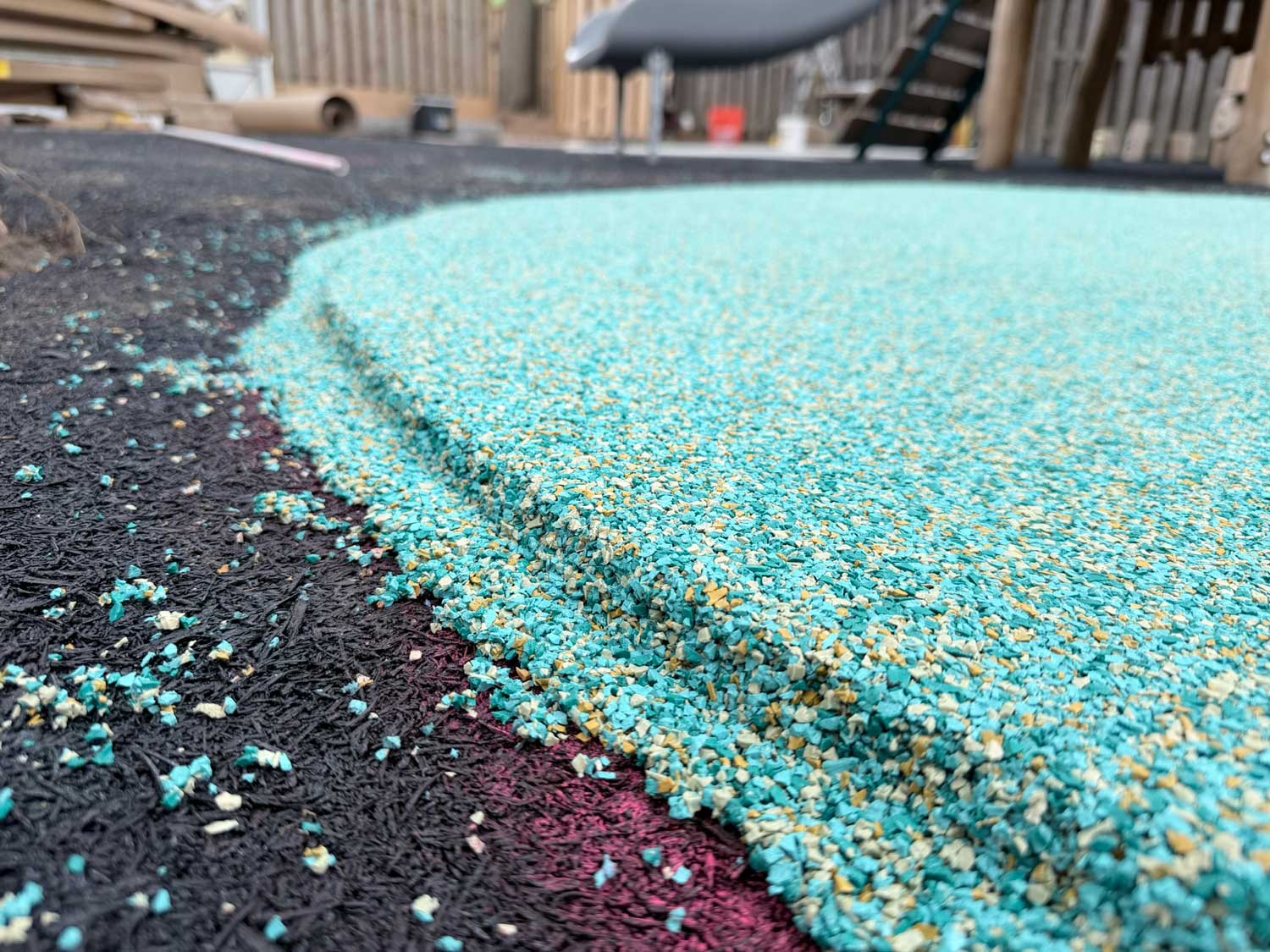
Unlike a permeable paver system, where water can only get through the joints between individual pavers, a Playpave surface is porous across its entire footprint. Our wearing course is built from 1–4 mm EPDM rubber granules bound with an aliphatic polyurethane binder over an SBR buffings base — a structure with open space built in throughout, not just at the seams. That means rain isn't funneled to a few narrow channels; it's absorbed everywhere it falls.
Putting it to the test
We recently ran our own permeability and drainage testing, based on ASTM F1551-03 (the standard test method most commonly used to characterize how bound rubber surfacing drains) and referenced against DIN 18035, Part 6. Using a system built with our standard EPDM/polyurethane wearing course, we ran six timed drainage trials and measured how quickly water moved through the surface.
The result: an average drainage rate of 1.2 gallons per minute — or roughly 72.9 gallons per hour — through the tested surface area, with consistent results across all six runs. That's a properly installed PIP system doing exactly what it's designed to do: moving water through the surface quickly rather than letting it pool or run off.
Why that matters beyond the playground
Most PIP playground surfaces are specified to be permeable for good reason. A porous surface:
- Reduces runoff volume heading into storm drains and municipal sewer systems, especially during heavy or fast-moving storms
- Lets play areas dry out and reopen faster after rain, instead of staying wet or puddled
- Keeps the surface cleaner, since standing water and debris don't accumulate the way they can on impervious materials
(The exception is intentionally impervious applications like splash pads or food-service areas, where controlled drainage and easy sanitizing take priority — those get a different system entirely.)
It's a system, not just a surface
One thing our testing reinforced: drainage performance isn't just about the wearing course. How well a PIP surface performs over time also depends on the sub-base underneath it — whether that's crushed stone, asphalt, or concrete — and its ability to move water away as fast as the surface lets it in. A well-designed Playpave installation accounts for both, so the permeability we measure in the lab holds up in the field, season after season.
As more towns look for ways to manage stormwater at the source rather than downstream, surfacing choices like this are becoming part of the conversation — not just for playgrounds, but anywhere a hard surface used to mean more runoff.